

Work with me
The Learning Lab
Protected time for the learning that doesn’t fit into subjects.
Most school timetables are organised around subjects, and for good reason: a big part of the way children and young people learn about the world is through rich, disciplinary knowledge.
But there are other important aspects of human development that don't fit neatly into subject-shaped boxes:
-
Physical wellbeing
-
Emotional self-regulation
-
Habit formation
-
Relational learning
-
Cognitive development
-
Moral and ethical development
-
Spiritual development

And running through all of it: the navigational work of understanding yourself and directing your own learning.
Learning Lab is our name for dedicated curriculum time, every week, for holistic personal development and interdisciplinary learning.
It is rooted in a simple insight: if we want young people to develop these capabilities, they need time to practise them.
What a Learning Lab includes:
There are many ways to design a Learning Lab. For example, it might include:
-
Learning to *be* lessons (e.g. see here)
-
Philosophical enquiry
-
Interdisciplinary learning
-
Self-directed learning
-
Independent research projects
-
Group research projects
-
Enterprise projects
-
Community projects
-
Public speaking
-
Debating
-
Meditation
-
Learning journals
-
Weekly reviews
The key principle is simple: if we want young people to develop these capabilities, they need time to practise them.
Where it began:
The idea grew out of my work as a secondary school teacher, where I helped create the Learning Skills curriculum – a whole-school approach to developing confident, articulate, self-regulated learners.
At Sea View, students took part in more than 400 Learning Skills lessons across Years 7-9.
That cohort achieved the best results the school had seen by some margin, and the disadvantage gap fell from 25% to 2% from one cohort to the next.
Here's the part that surprises people.
Students in the Learning Skills cohorts had around 400 fewer subject lessons than the control cohort. And yet in subsequent measures of subject learning, they performed significantly better.
Time spent learning how to learn did not come at the expense of learning itself. It improved it.
The research behind Learning Lab:
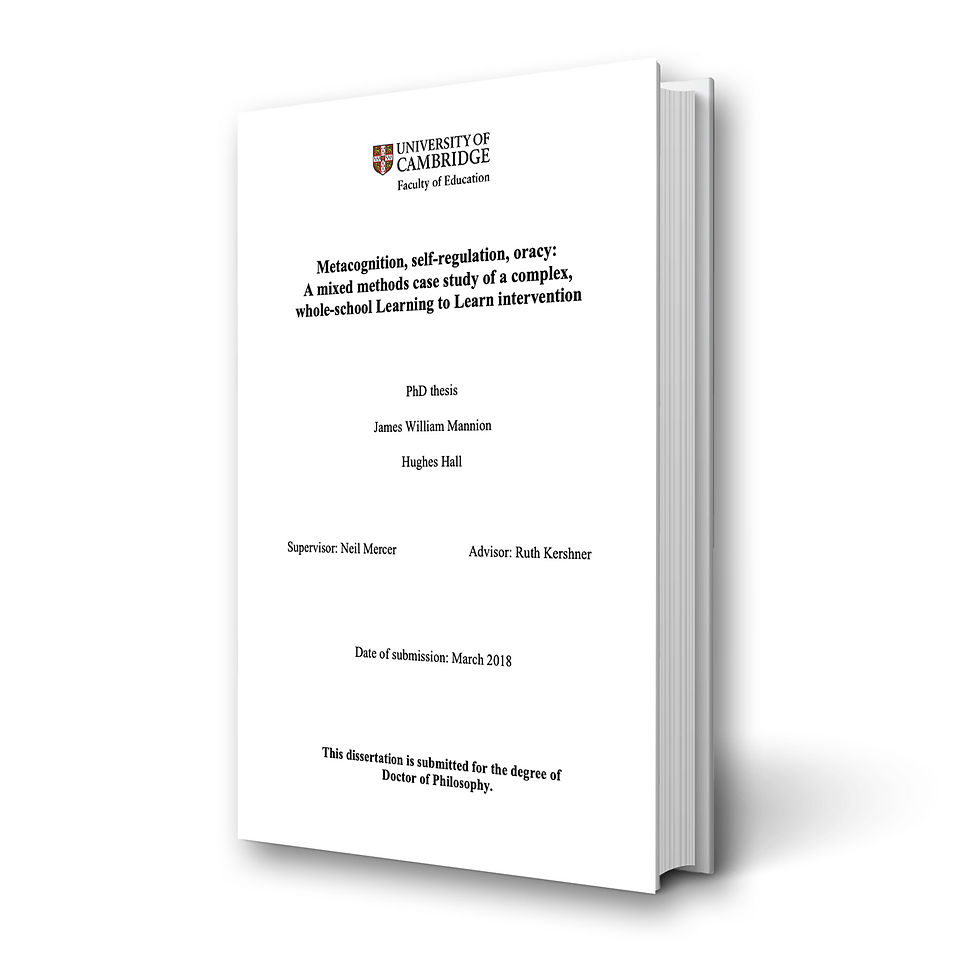
This work became the focus of my PhD, an eight-year study of the relationship between dedicated curriculum time, self-regulated learning and academic outcomes. I also wrote a more readable version with my colleague Kate McAllister.
You can explore the research in more detail here:

Where it's gone since:
Since the original Learning Skills work, we've helped schools develop similar approaches in England, Wales, South Africa, Australia and China, and the pattern has held.
At Knysna High School (“Tuskies”) in South Africa, we implemented an approach closely based on the Sea View model: one dedicated lesson each day, around 20% of curriculum time, for all students in Grades 8 and 9 (equivalent to years 9 and 10 in England).
Already a high-performing school, Tuskies went on to record its strongest Grade 8 and Grade 9 results in at least five years – despite the Learning Lab cohorts spending a fifth of their curriculum time outside subjects.
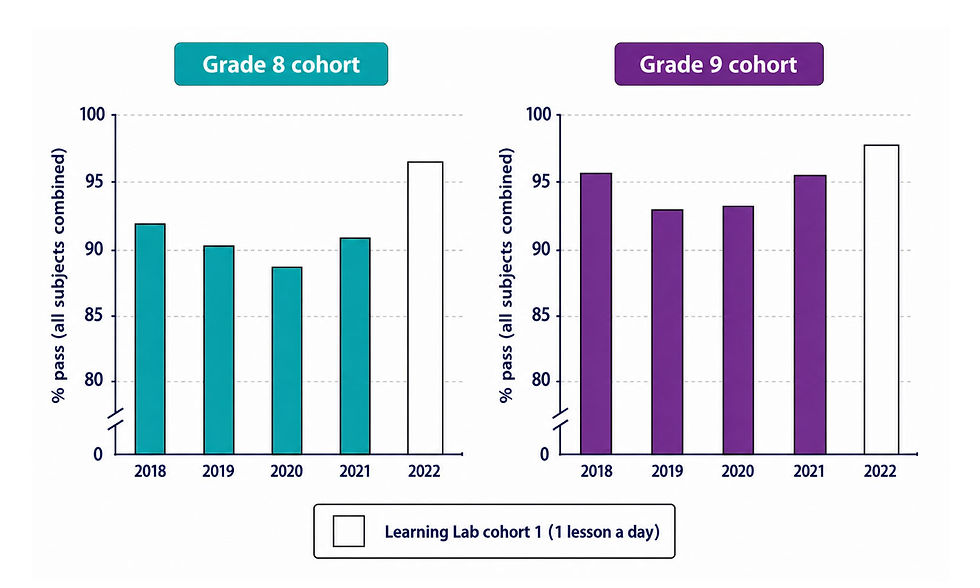
These experiences have reinforced something we saw at Sea View: when schools deliberately create time for young people to develop as learners and as people, that time doesn't compete with academic learning – it supports it.
How we work with schools:
There is no single Learning Lab model. Every school has its own curriculum, staffing, timetable, priorities and starting point. So we work with each school in a bespoke way to design something that fits your context.
Depending on what you're trying to achieve, this might include:
-
Scoping and visioning: Working with school and trust leaders to establish what you want Learning Lab to achieve and how it fits with your wider curriculum and improvement priorities.
-
Curriculum design: Developing a coherent programme of learning, tailored to your pupils, staff and context.
-
Staff training and demonstration lessons: Helping teachers develop the knowledge, skills and confidence to deliver a Learning Lab effectively.
-
Implementation support: Coaching and supporting leaders and staff as the approach becomes established.
-
Evaluation: Helping you understand what's working, what needs adapting, and what difference the approach is making.
Interested in Learning Lab?
If you're considering dedicated curriculum time for holistic personal development and interdisciplinary learning, I'd be happy to talk through what this could look like in your school or trust.
Fees work on a sliding scale depending on the size of your school.
The easiest way to find out more is to drop me a line, or schedule a free 30-minute call to talk it through.


